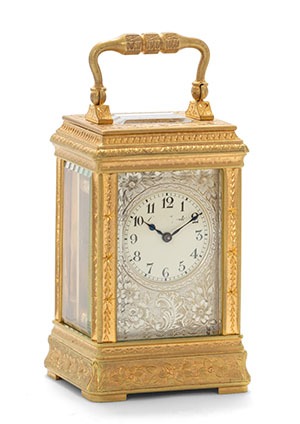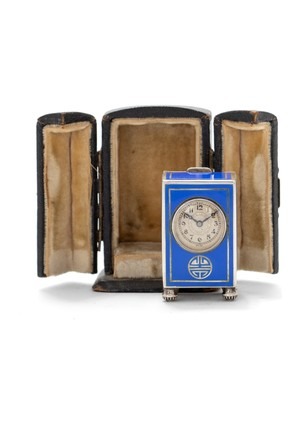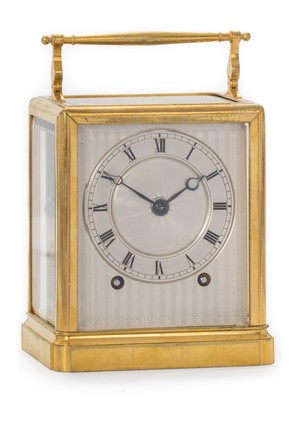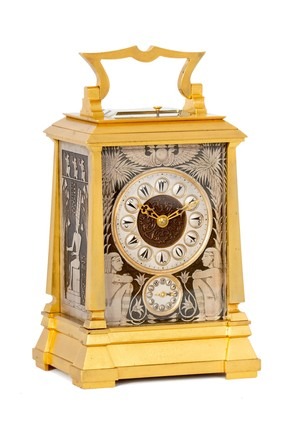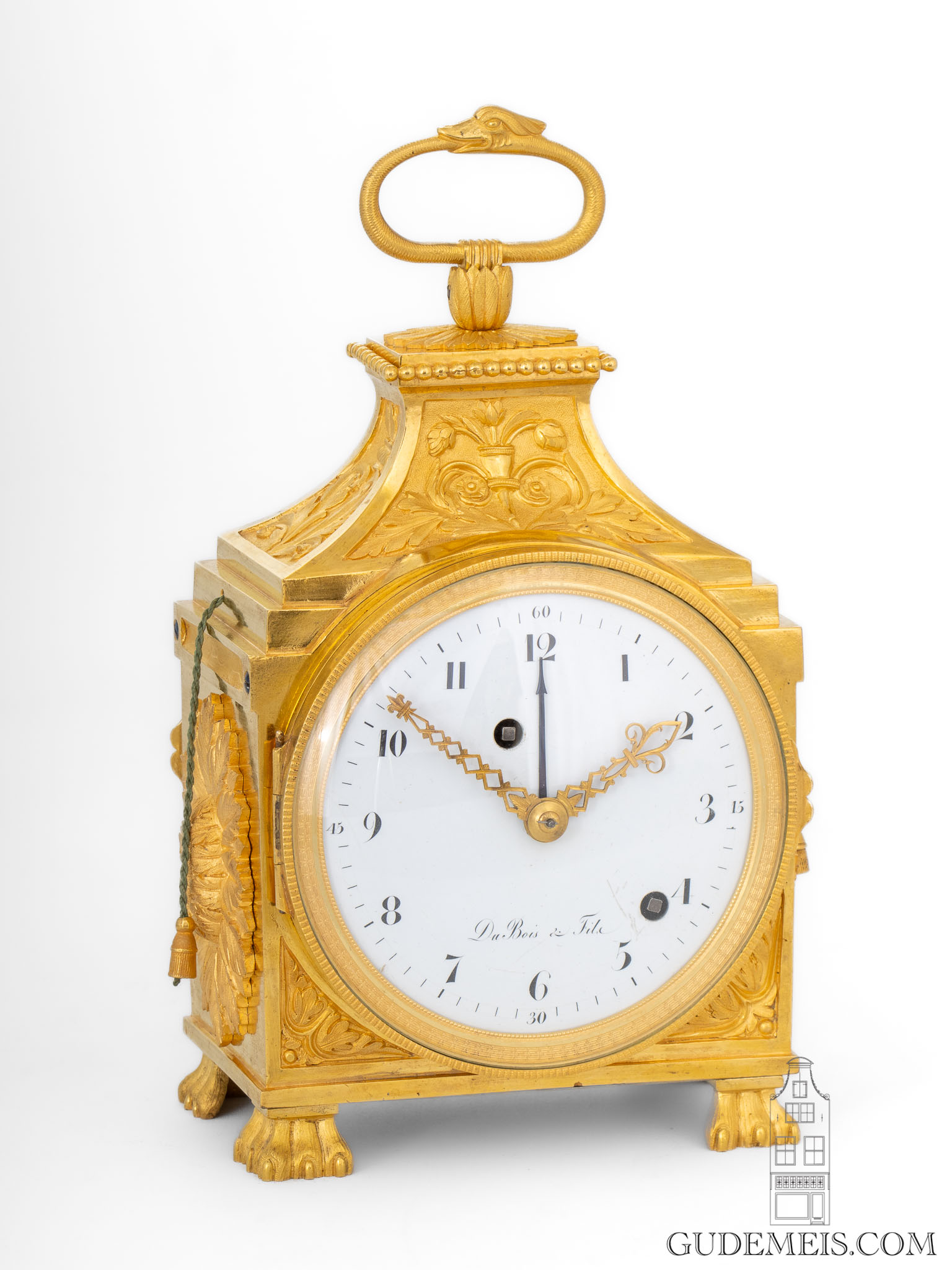
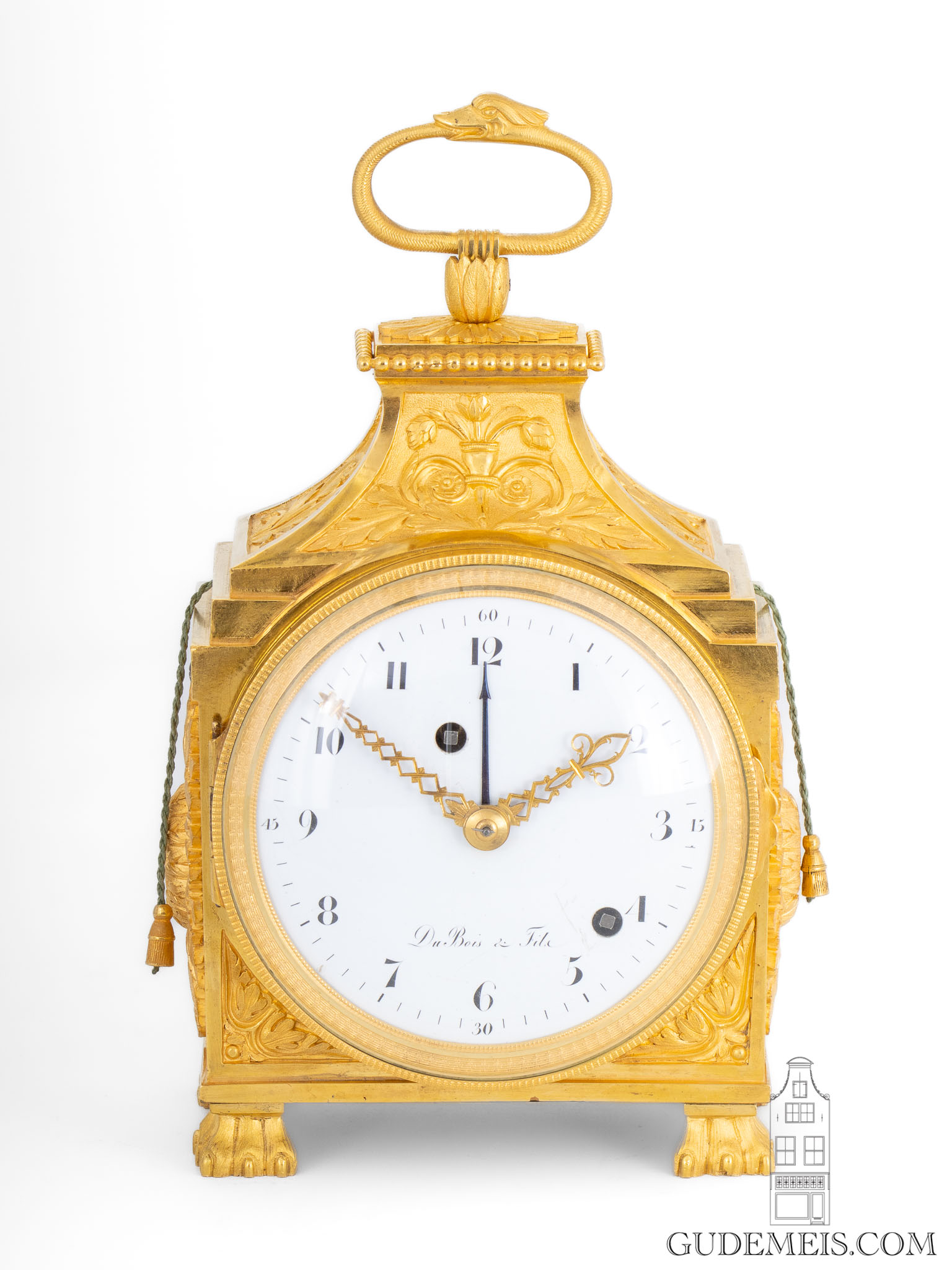
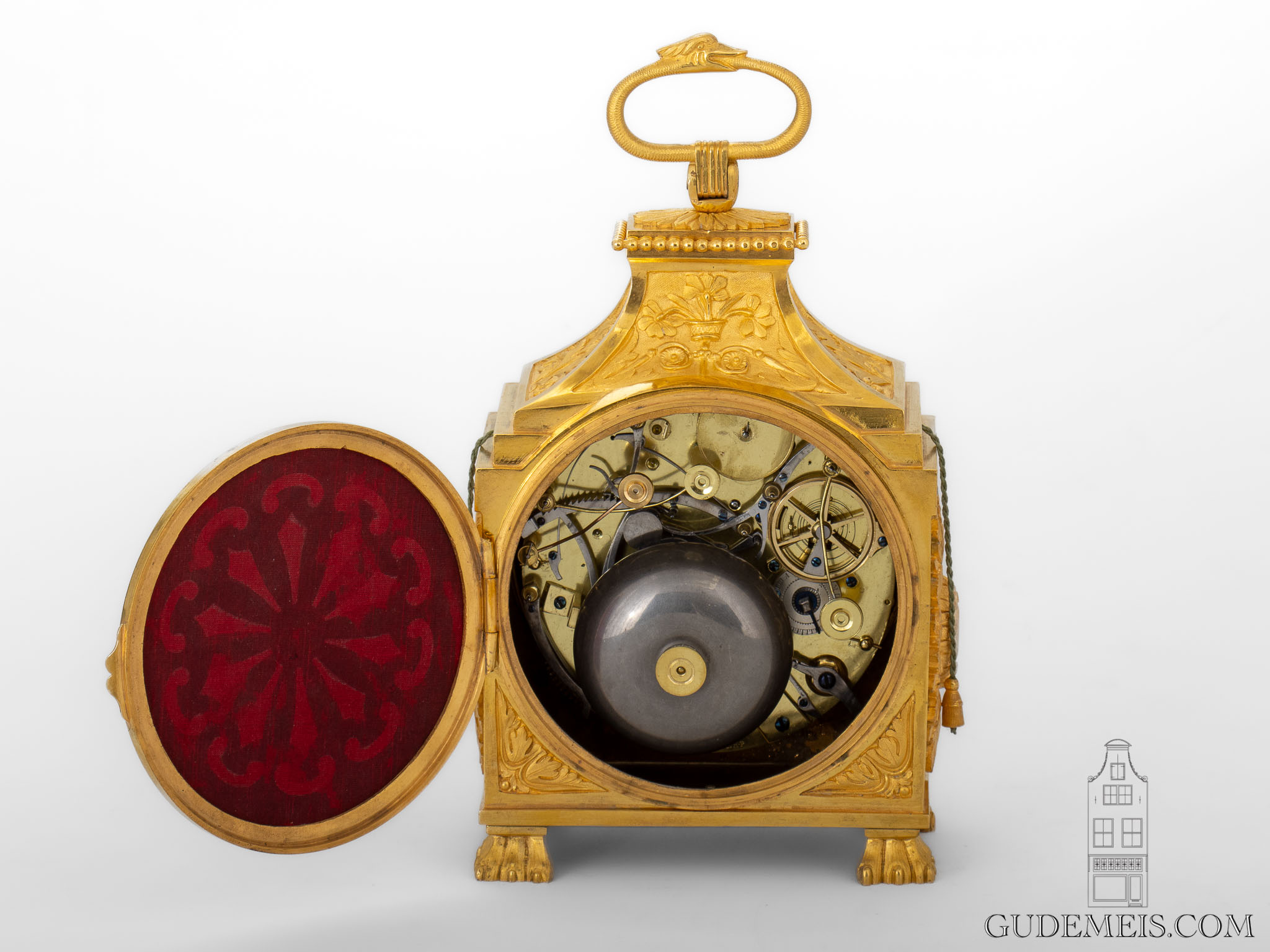
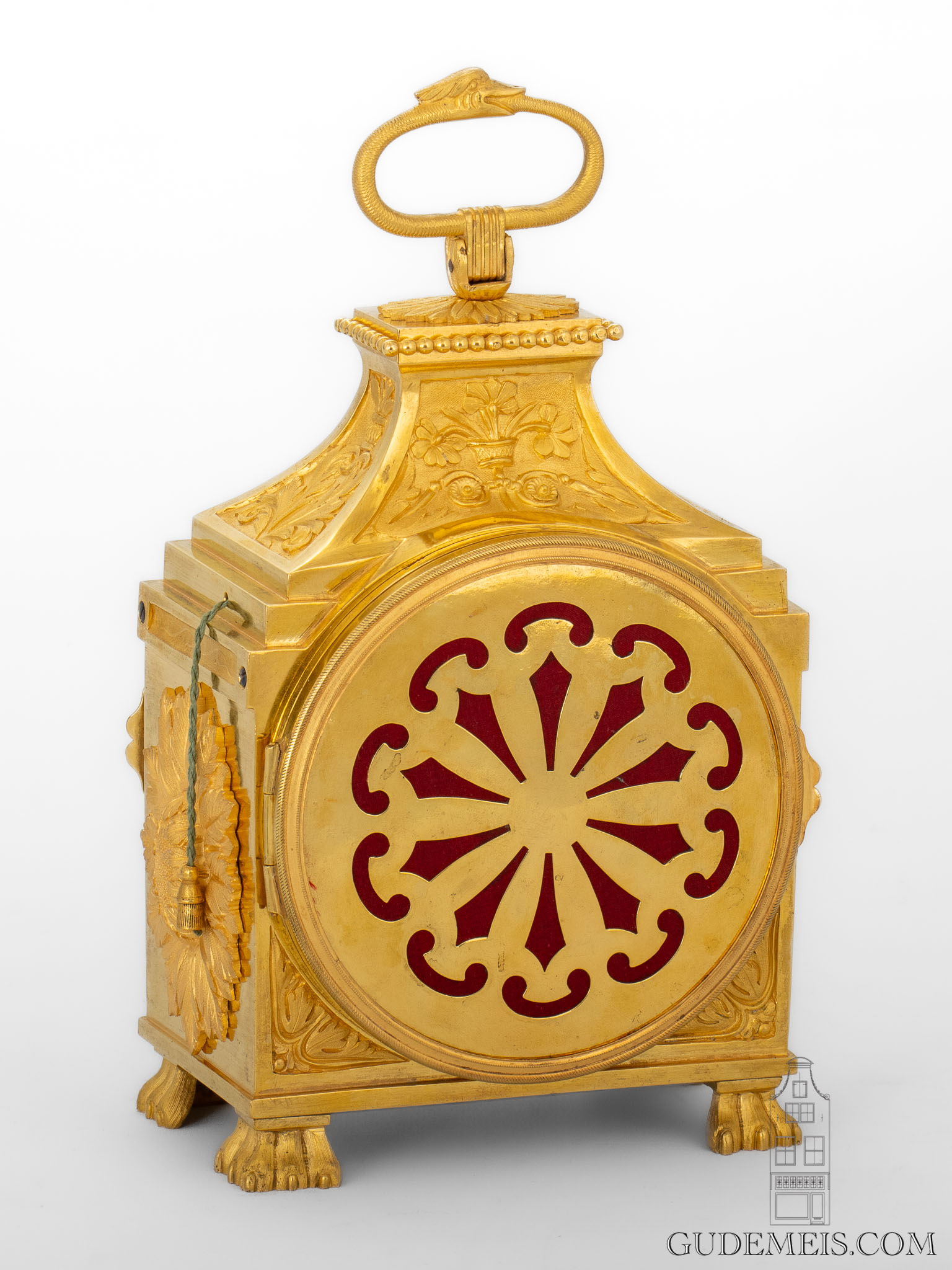
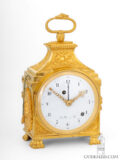
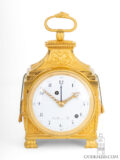
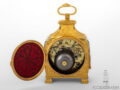
A Swiss Louis XVI ormolu quarter striking and alarm pendule d’officier, Du Bois & Fils, circa 1790.
Description
Pendule d’officier
This a ‘pendule d’officier’ which is an early type of travel clock that was provided with an expensive case made of gilt bronze or exotic woods. Although the term translates to ‘officer’s clock’ it was not only used by the military but also by the upper echelon of society who afford one.
It was either the small demand or the small production which made that travel clocks were very rare before the second quarter of the nineteenth Century. From the clocks that have survived we can conclude that from 1760 on there was a small demand for travel clocks. Many of these early clocks are very individual in appearance and were probably executed with features bespoke beforehand by the client for which it was made. Around 1790 in the Jura located in the border region of France and Switzerland a production evolved that was more standardized. These were made to be sold by others and to accommodate the wishes of potential clients these clocks were executed with many different features. And so this fine clock was executed with quarter striking, repetition and alarm. All very useful for travel or the sleeping quarters. The compact ormolu Louis XVI case was not only practical but also very attractive which many still find today.
Du Bois & Fils
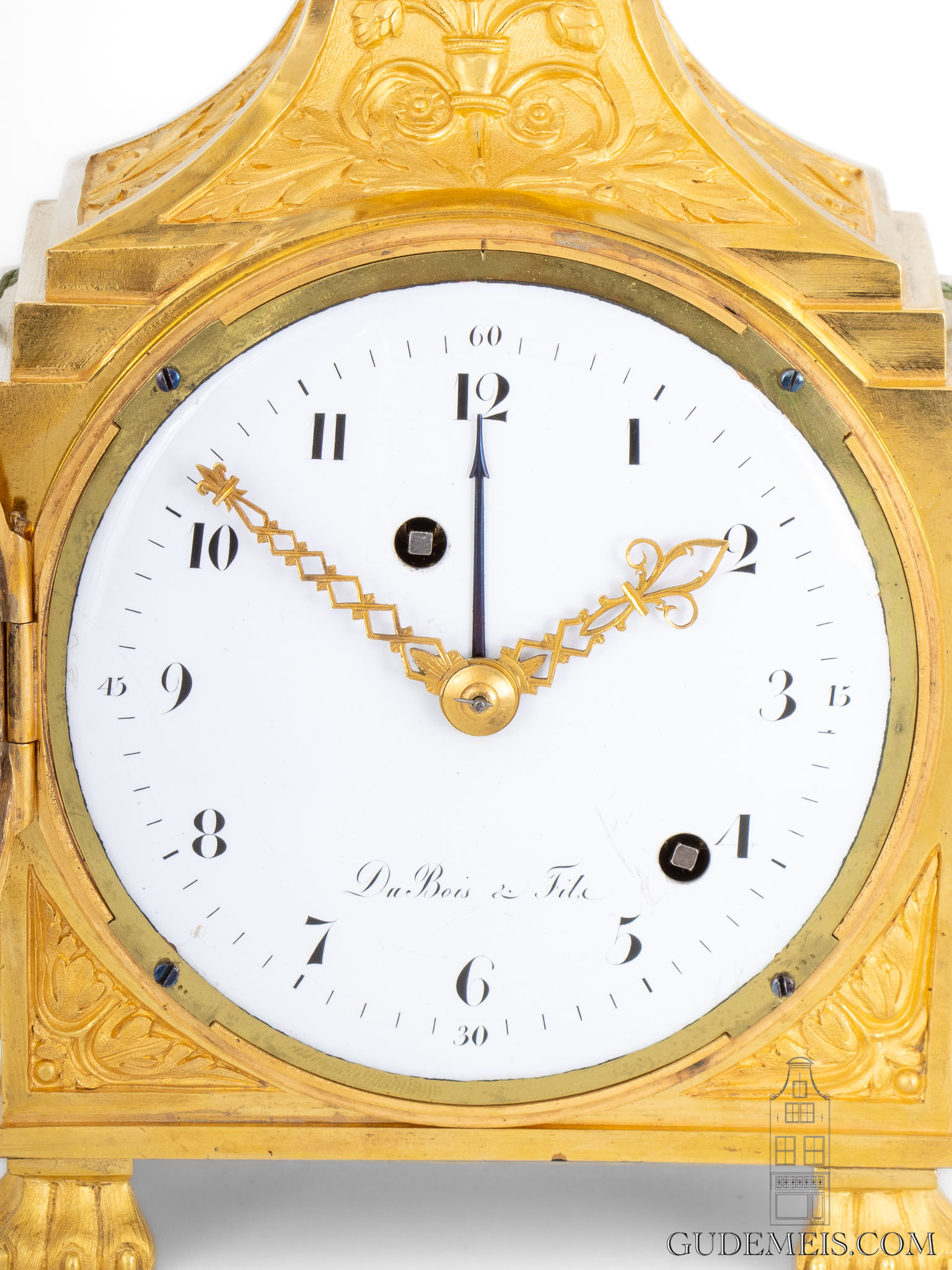
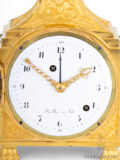
The enamel dial features Arabic numerals for the hours and a minute band with quarter-hour markings. The center is signed Du Bois & Fils. The beautifully pierced and engraved fleur-de-lis hands are made of gilt brass, the alarm hand is made of blued steel.
petite sonnerie
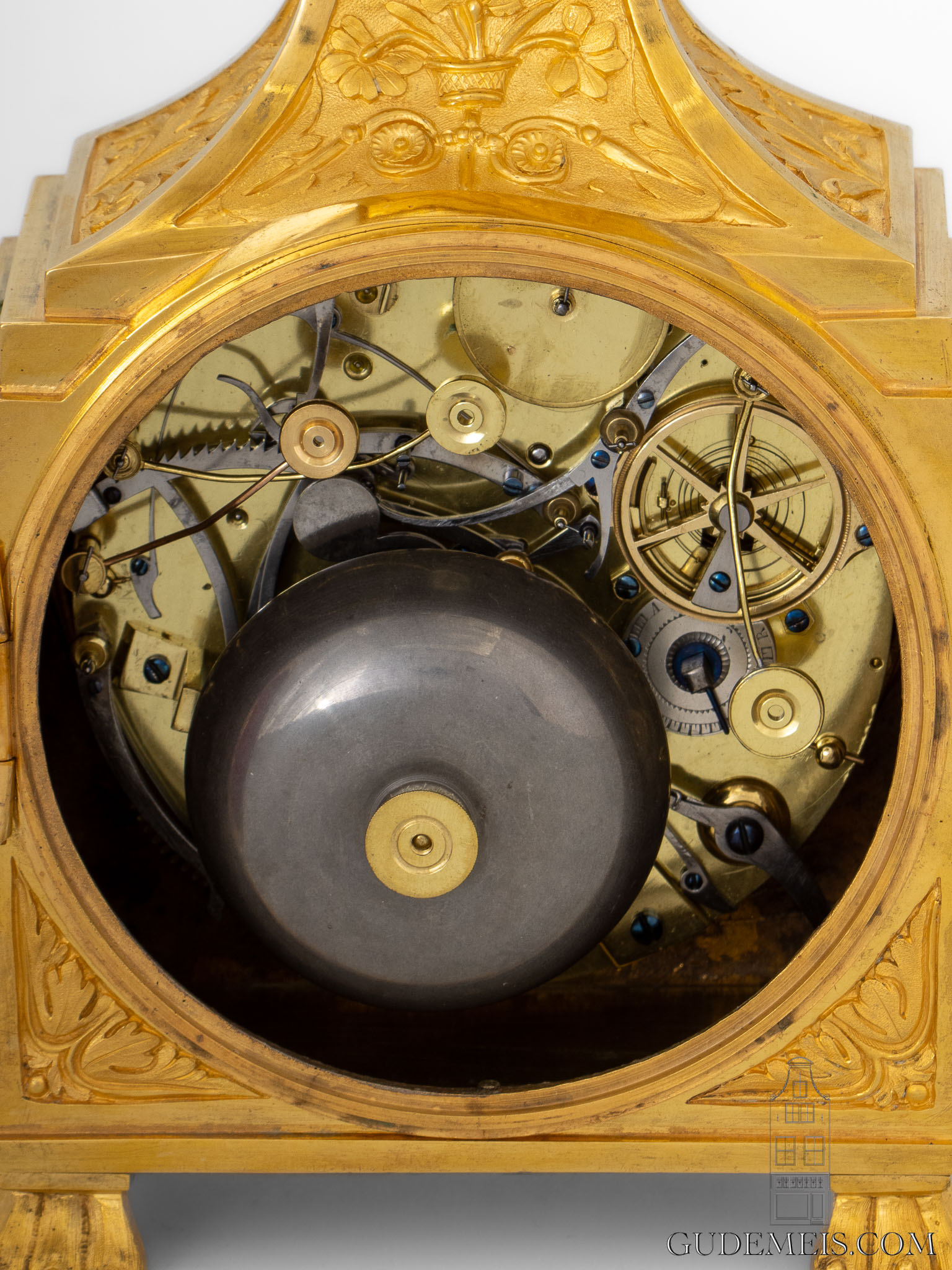
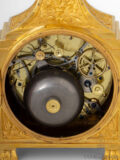
The movement is driven by two spring barrels and has a power reserve of one and a half days. It is regulated by a verge escapement in combination with a balance wheel. The clock has quarter striking on two bells, by mechanism of rack striking with a repeating. Additionally, the clock has an alarm with a pull-wind spring. Finally, there is a lever on the bottom that can be used to silence the striking mechanism.
Louis XVI
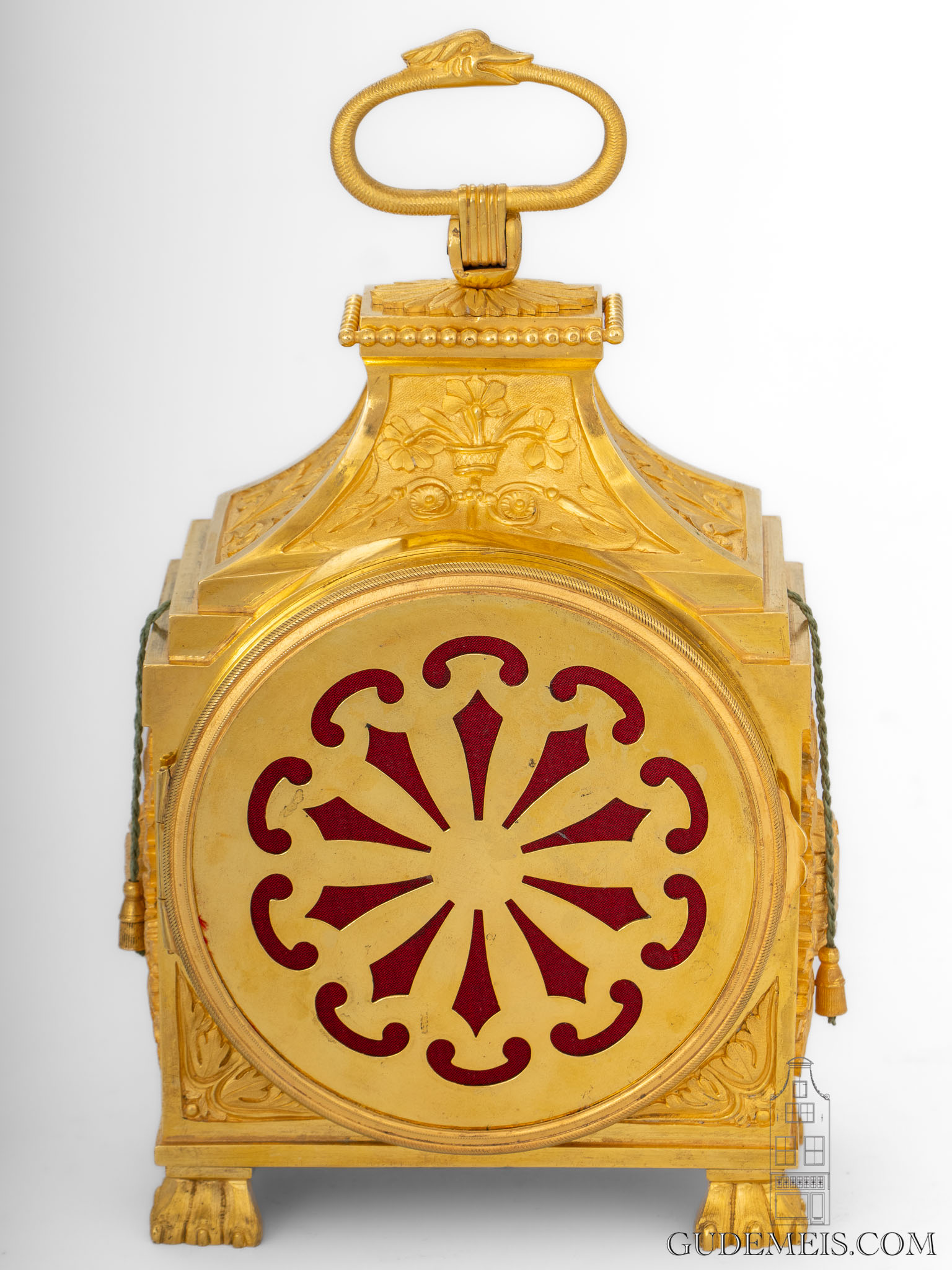
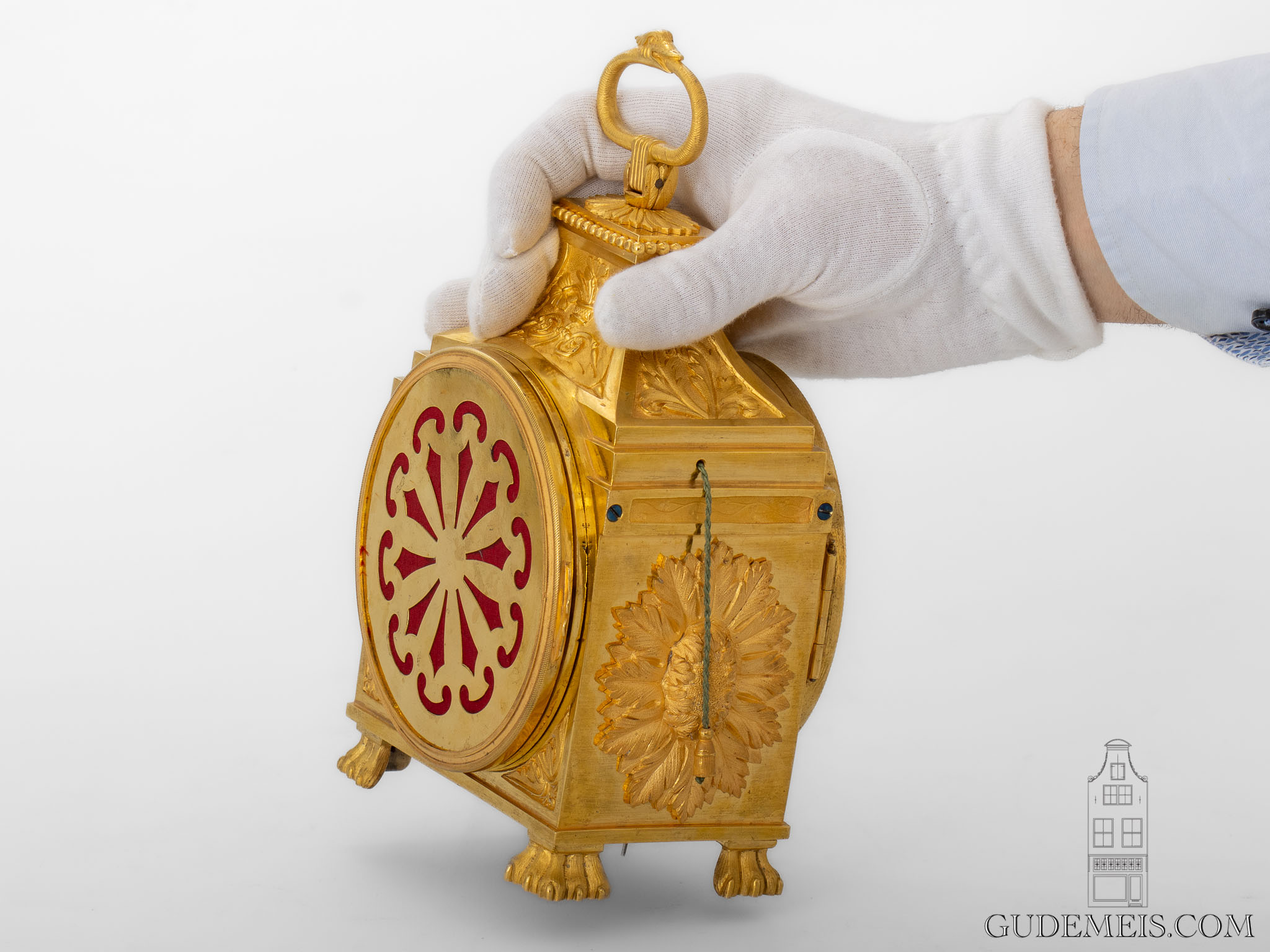
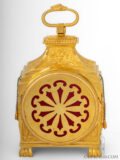
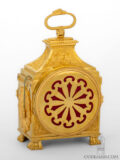
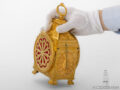
The gilt bronze case a top with concave sides adorned with acanthus relief, surmounted by a handle shaped like a serpent biting its tail. Large rosettes are mounted on the sides, which, like the acanthus leaves, are characteristic of the Louis XVI style. The clock is raised on square claw feet