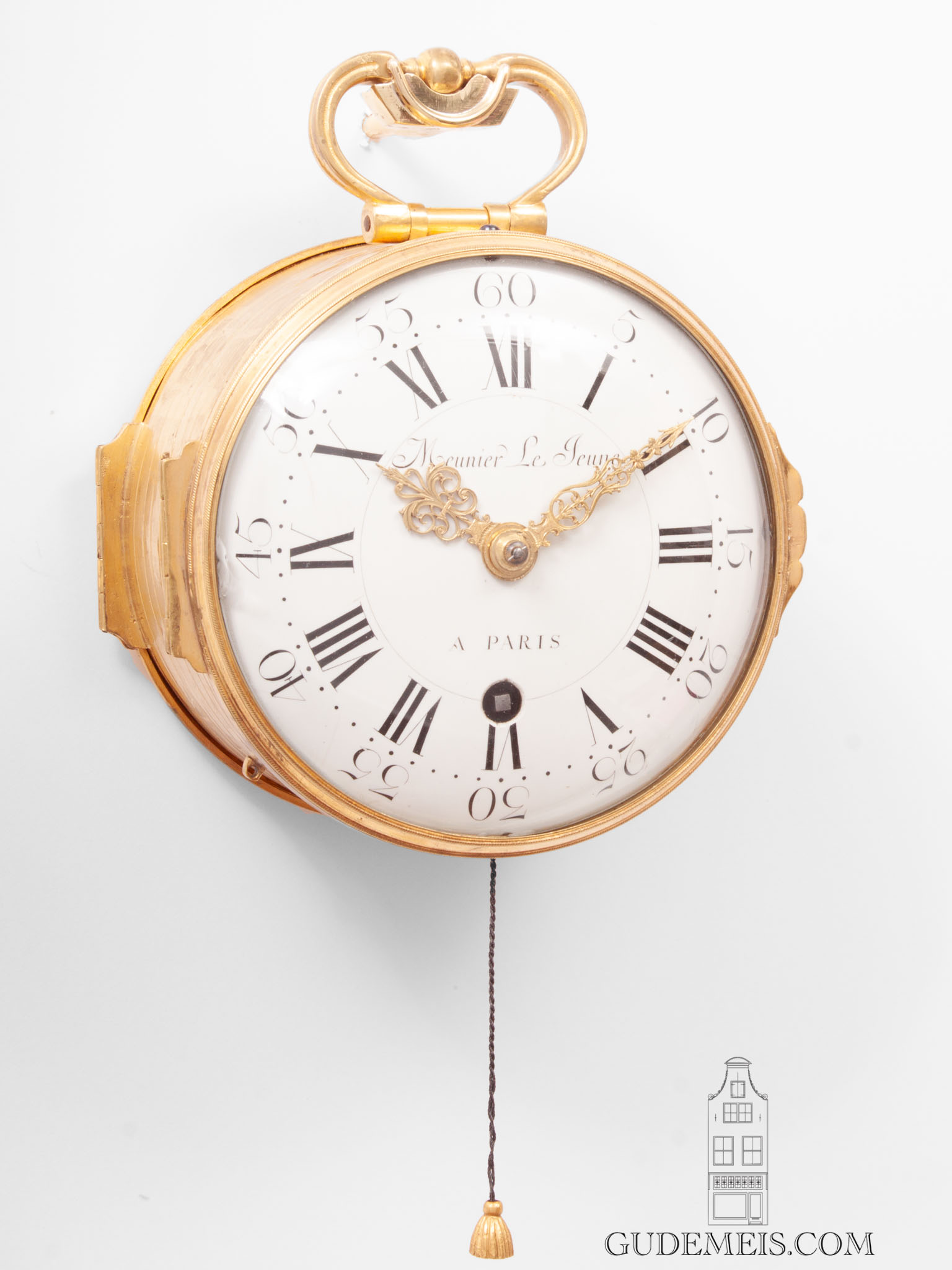
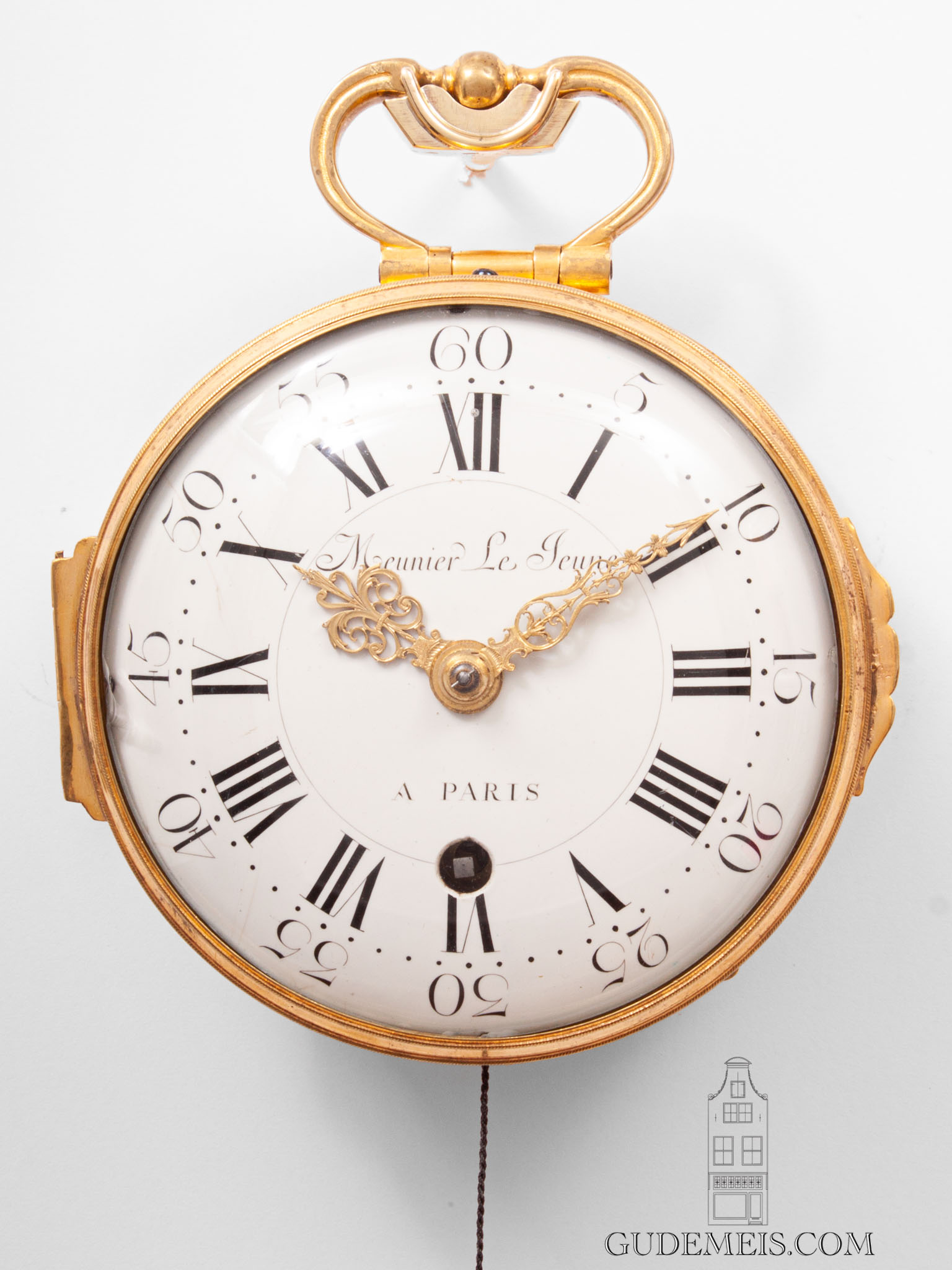
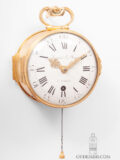
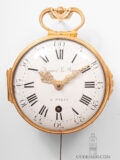
An early French Louis XVI gilt quarter repeating travel clock, Meunier Le Jeune Paris, circa 1780.
Description
Travel clock
In the third quarter of the eighteenth century, there must have been a growing need for travel clocks. I can state this because both the ‘Pendules d’Officier’ and ‘Capucines’ originated around this time. In this early period, the production was still small, which caused them to be very individual, differing by maker. Besides these ‘Pendules d’officier’ and ‘Capucines’, which must be placed on a surface, there were clocks that could be hung. Often these clocks are called ‘coach clocks’ or ‘coach watches’, suggesting that these were hung in a carriage. This might very well be possible, but it is also very likely these clocks were hung on a nail or hook in the room one was staying overnight. This clock does not strike on its own but is able to repeat the hours and quarters on demand. In this way, one could know what time it was in the dark, which was very handy in a time when making light involved making fire. While the functional and modest exterior was practical during travel in earlier days, nowadays it is these characteristics that make it fit easily into any interior. Practical and rare for this type of clock is that the clock has a movement with a duration of eight days.
Meunier Le Jeune
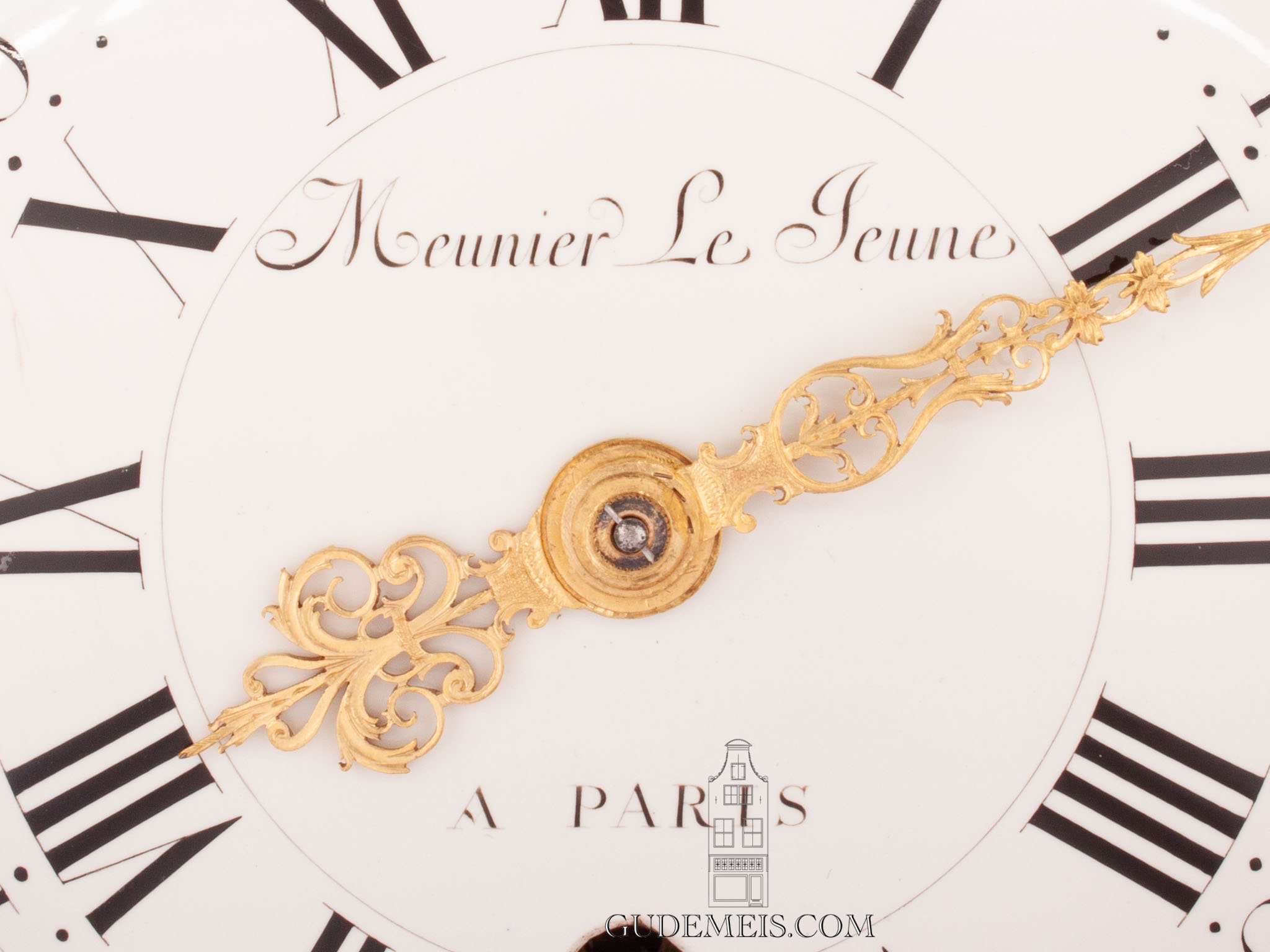
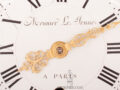
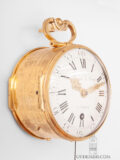
The enamel dial has Roman numerals for the hours and Arabic numerals for the five minute indication. The centre is signed Meunier Le Jeune A Paris. The beautiful foilate and engraved pierced hands are made of gilt brass. Both the style of the numerals and hands are typical for the Louis XVI period.
Cylinder escapement
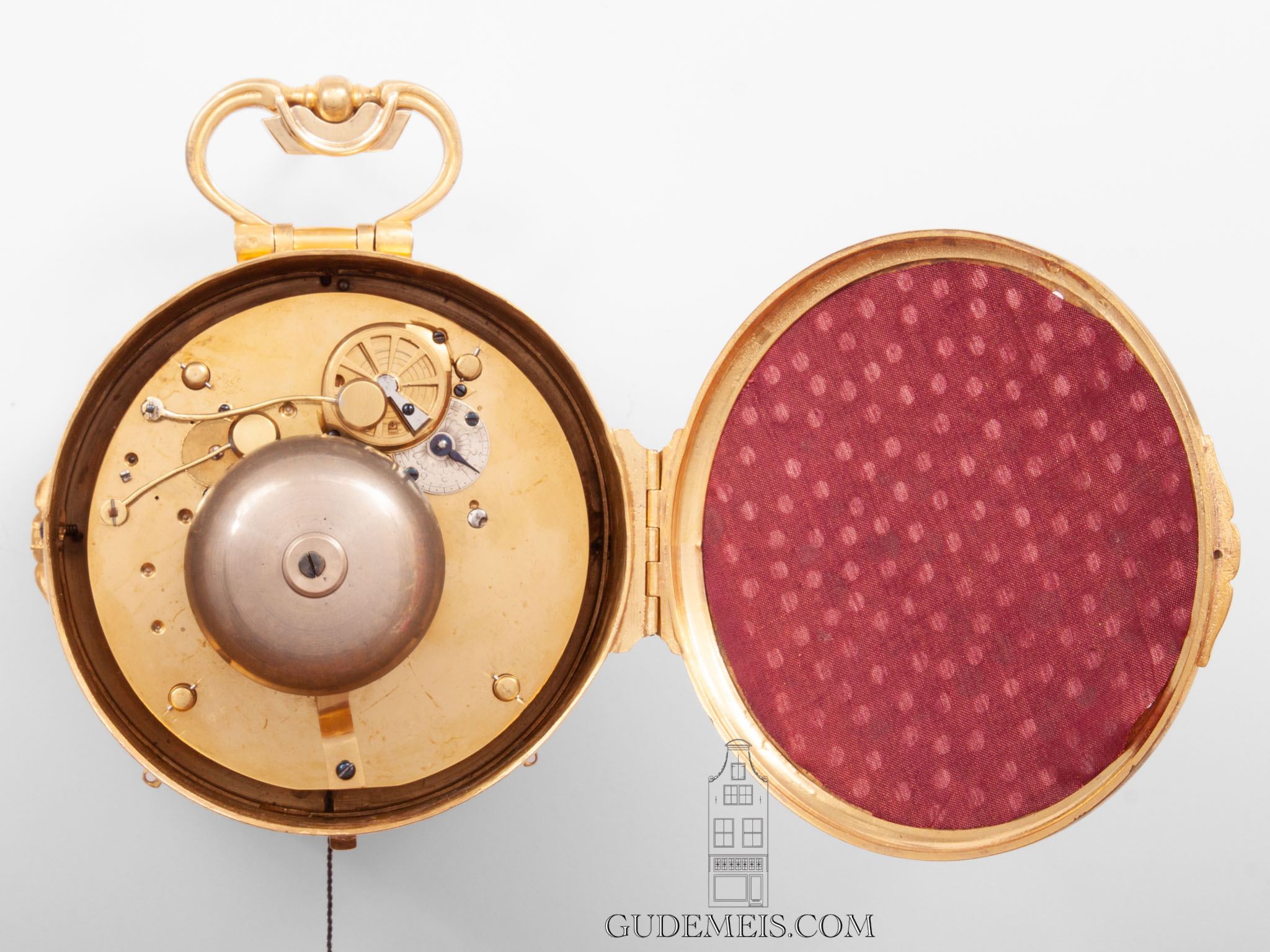
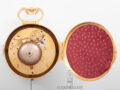
The eight day duration, annular plated movement, is driven by a spring barrel in combination with chain and fusee. This fusee mitigates the diffences in power that occur when the spring is unwinding. The rate is regulated by a cylinder escapement in combination with a plain balance which has a balance spring and fine regulation. By pulling the string, an auxiliary spring is wound to strike the hours and quarters past on two bells.
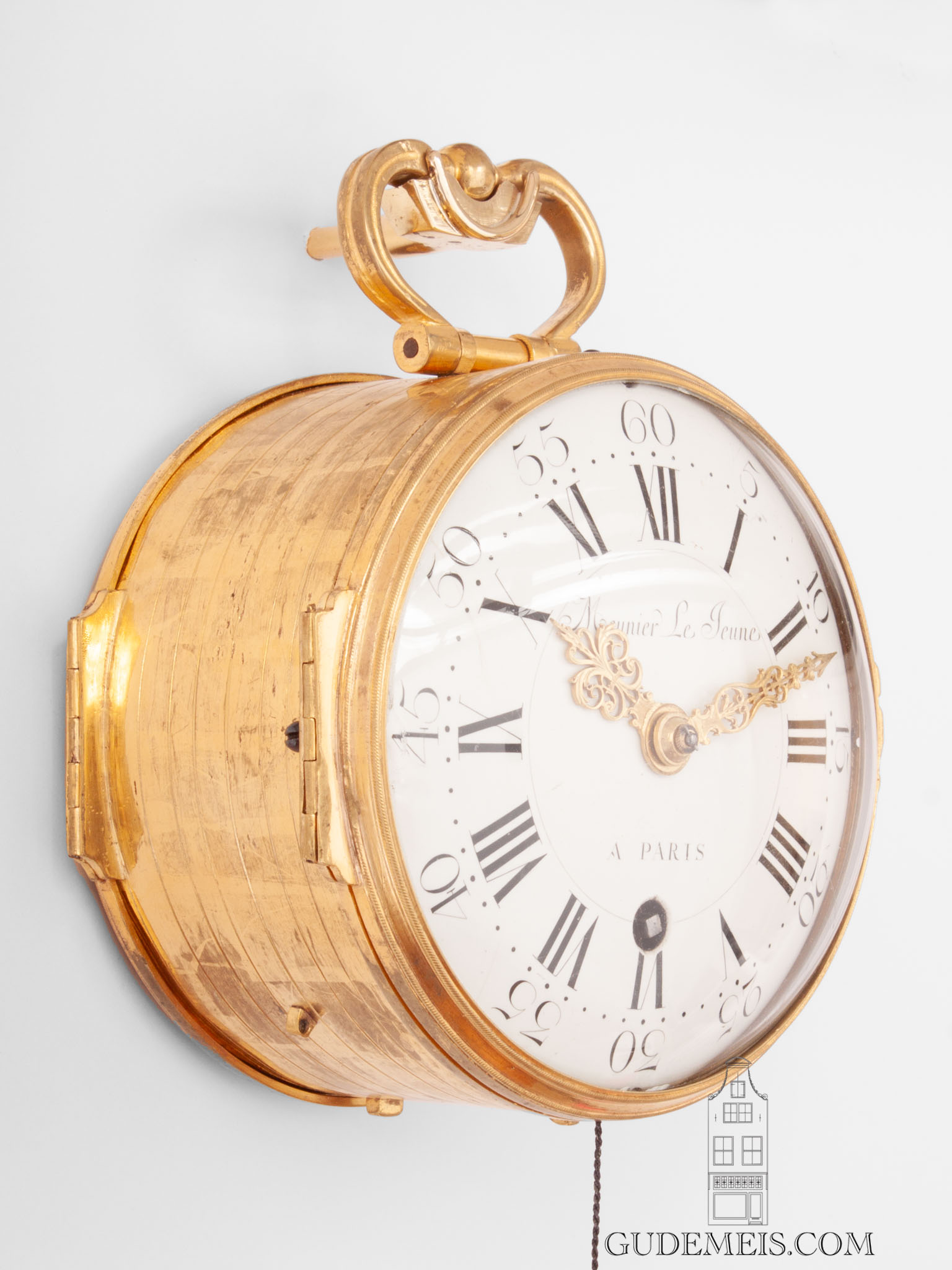
Ormolu case
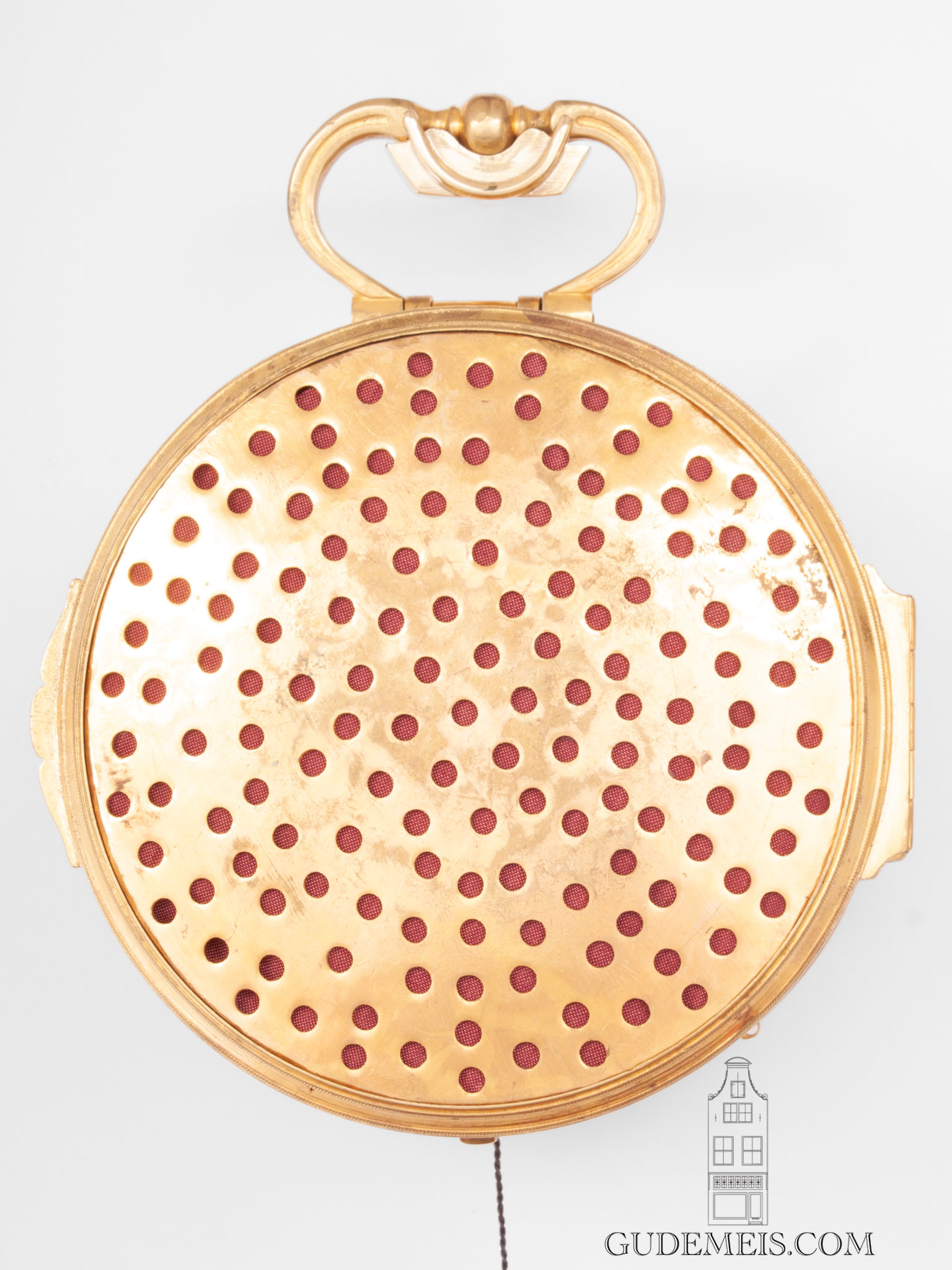
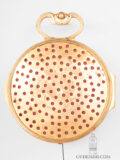
The movement is fitted in an annular functional ormolu case. It is adorned by engraved lines and surmounted by a cast handle. The back door is pierced to let the sound of the quarter repeating through. The whole is hung on a hook on the wall.