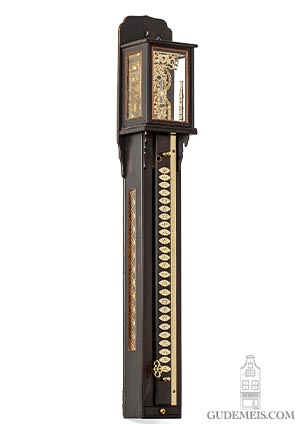
A Japanese mother of pearl inlaid shaku dokei wall clock, circa 1840.
Description
Shaku dokei
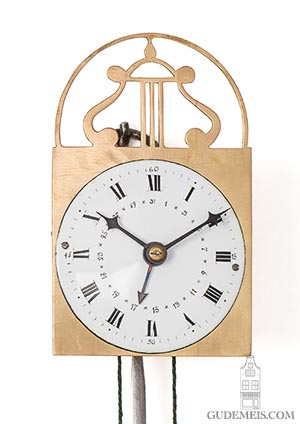
This type of Japanese wall clock is referred to as ‘shaku=dokei’. A ‘shaku’ is unit of measure with the length of about a foot. ‘Dokei’ is the Japanese term for clock. Since most of these clocks are of this size the name ‘shaku=dokei’ must have stuck. The hand or pointer that indicates the time is fixed to the weight driving the movement. With the movement running, the weights with pointer, descends along the numerals on the lower part of the case. Because the construction is relatively simple these clocks could be made cheaper and were affordable for more people. Until 1873, the Japanese used ‘temporal hours’. This means that the day, and first hour, starts at sunrise. And that the day, and last hour ends at sunset. Both day-time and night-time was divided into six toki (unit of time). It also means that length of the toki changes with the changing of seasons. Therefore the Japanese clocks needed to be adjusted to the ever changing length of the toki. With early ‘shaku-dokei’ the numerals can be moved. Later clocks of this type had sets of dials that needed to be changed every two weeks. With the abolition of the temporal hours these adaptations became obsolete. To keep these clocks useful, sometimes these clocks were issued with a dial with western numerals like it is in this case. The Japanese artisans are renowned for their beautiful and skilful work. Many years of training lead to near-perfection in execution and artistry, as is the case with this clock. Looking at the precise way the parts of the movement were made, it is hard to believe all was done by hand and not by machine. Yet, the engraving shows the much more playful and artistic side of the makers. The same can be said of the case. The Japanese were famous for their lacquer, which was made through a painstaking process involving many layers of varnish while fighting the tiniest speck of dust. This rigid and precise way of working contrasts with the playful inlay of leaves executed in different shades of mother-of-pearl, again showing the more artistic creative side of Japanese craftsmanship. This lovely clock was made in the second quarter of the nineteenth century when traditional Japanese timekeeping was still in use. After the adoption of Western timekeeping, the dial was changed to Roman numerals to keep the clock functional. The later dial is not only a part of the interesting history of this clock, it might just have been the reason why it is still here, since it could still be used as a timekeeper.
Chrysanthemums
The weight driven movement has well turned pillars connecting the top and bottom plates and is of day duration. The front plate is finely pierced and engraved with chrysanthemums. The movement is regulated with a plain balance.
Mother of pearl inlay
The rectangular case with Japanese lacquer has mother of pearl inlay throughout. The front has a decor of stylized geometrical leaves. The sides, top and bottom a decorated with freer leaf decor. The case has a removable hood with slide-up front panel for winding up the weight every day. The rectangular lower part of the case holds the dial with engraved Roman numerals. At the bottom there is a small drawer for the winding key.