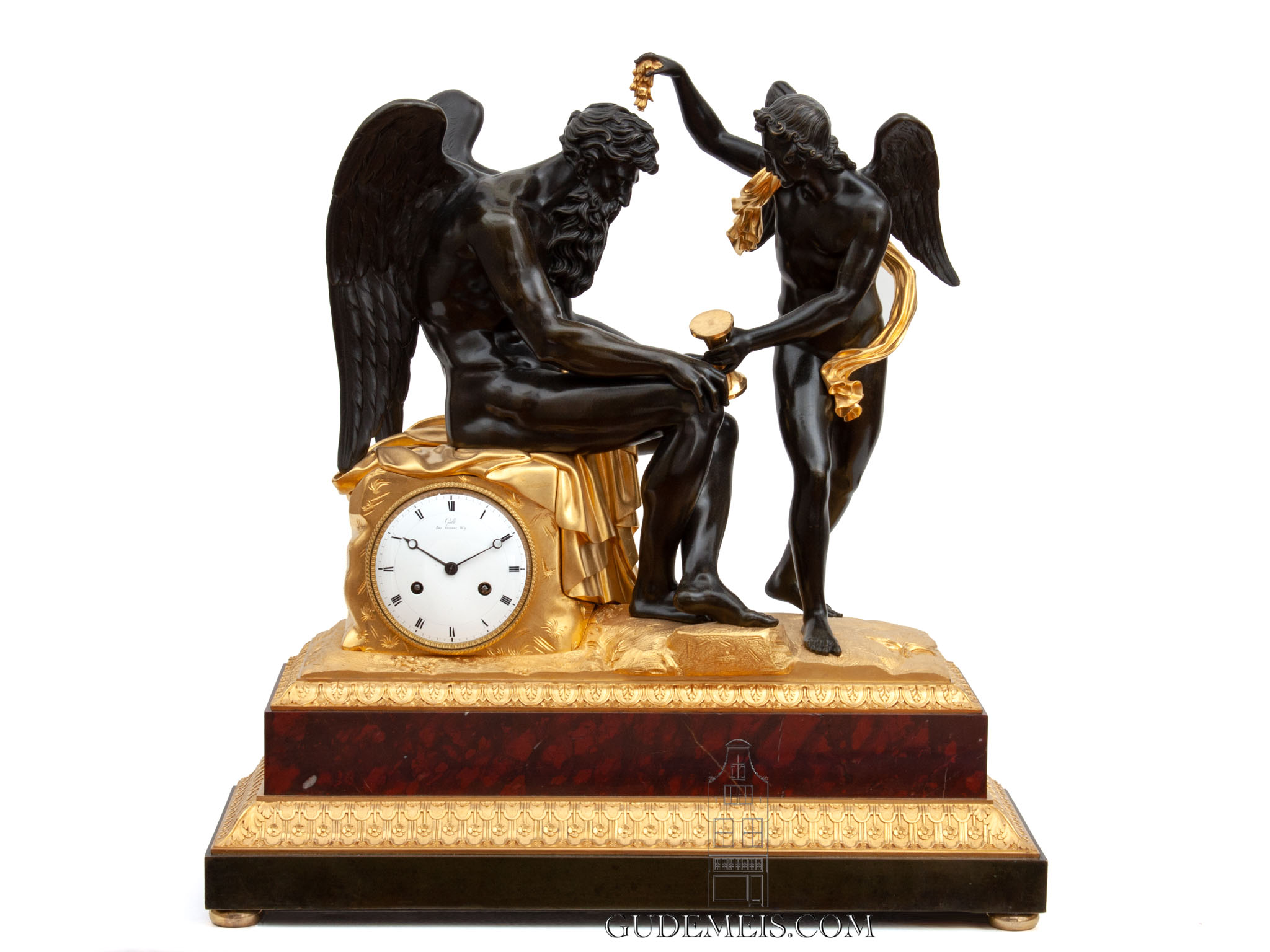
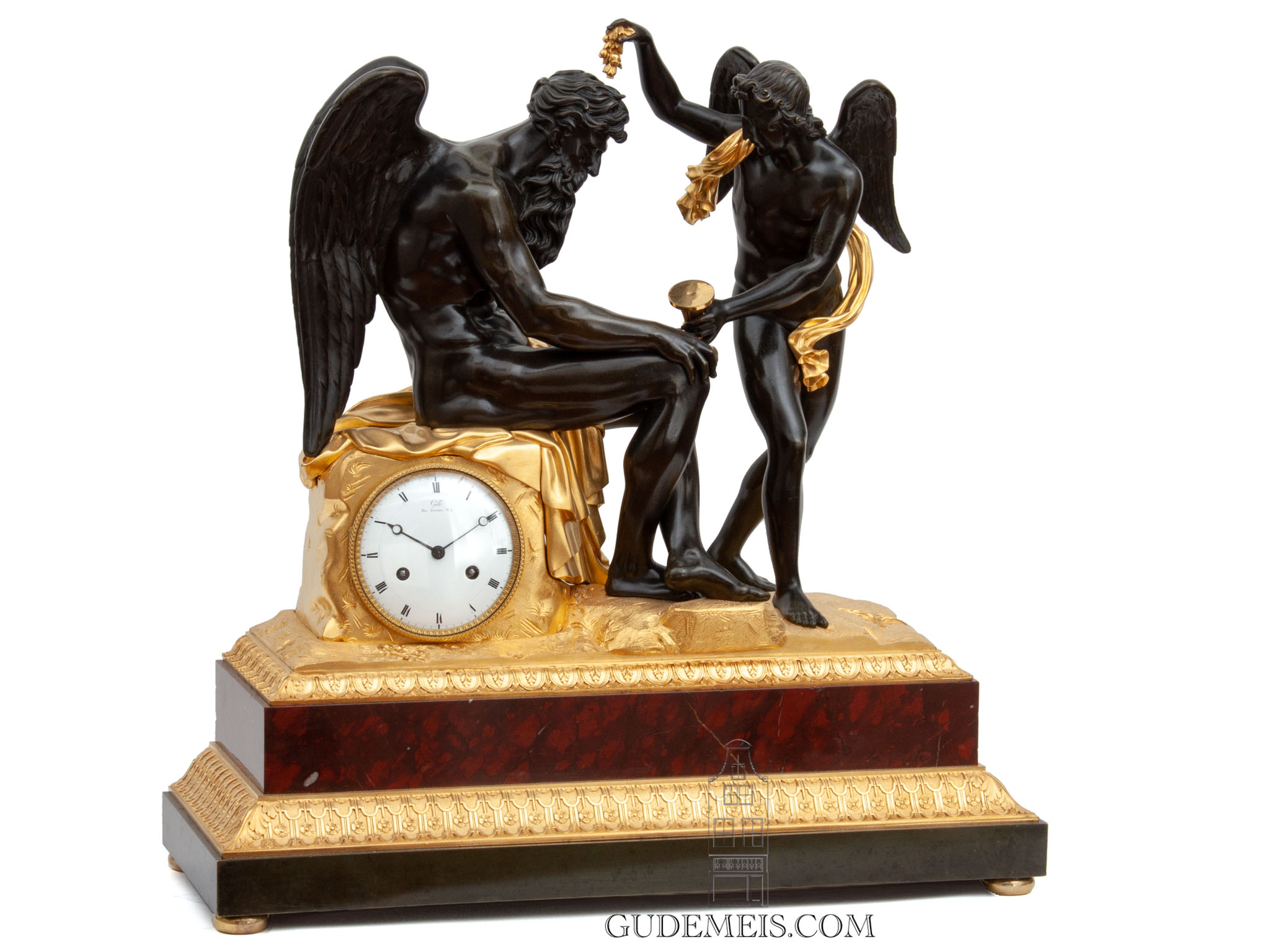
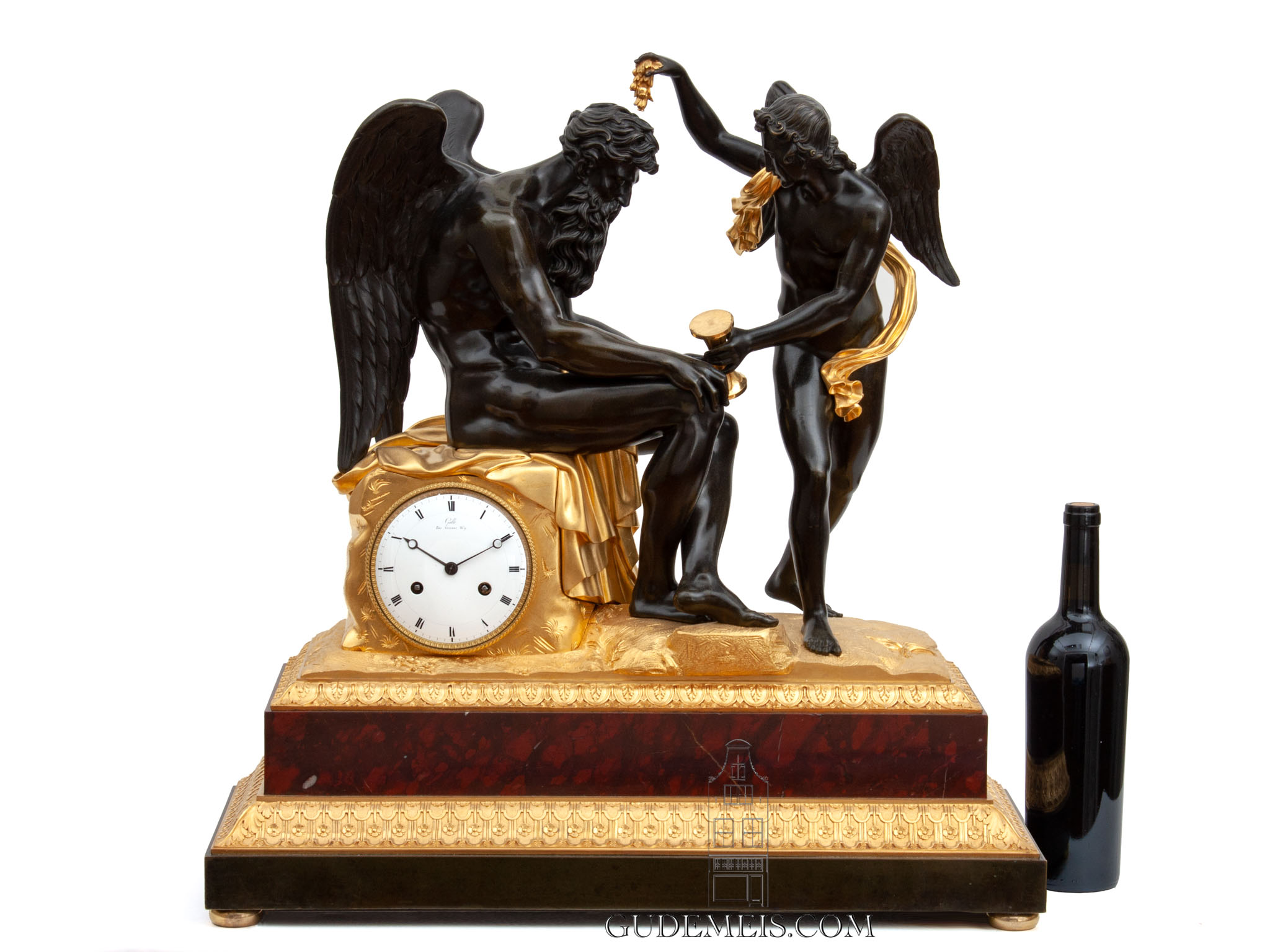





An imposing French Empire ormolu and bronze sculptural mantel clock, Claude Galle, circa 1810.
Description
sculptural mantel clock
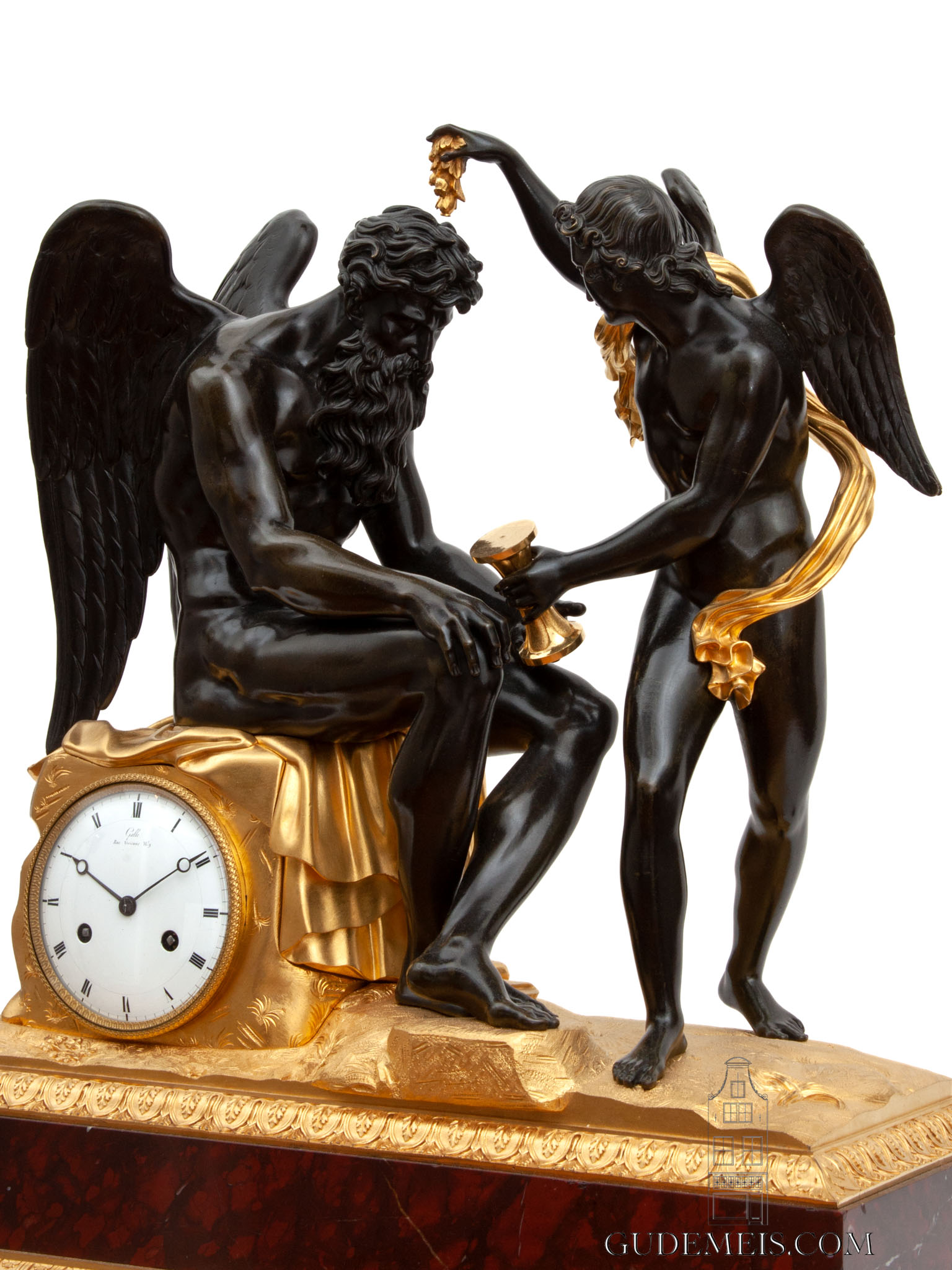
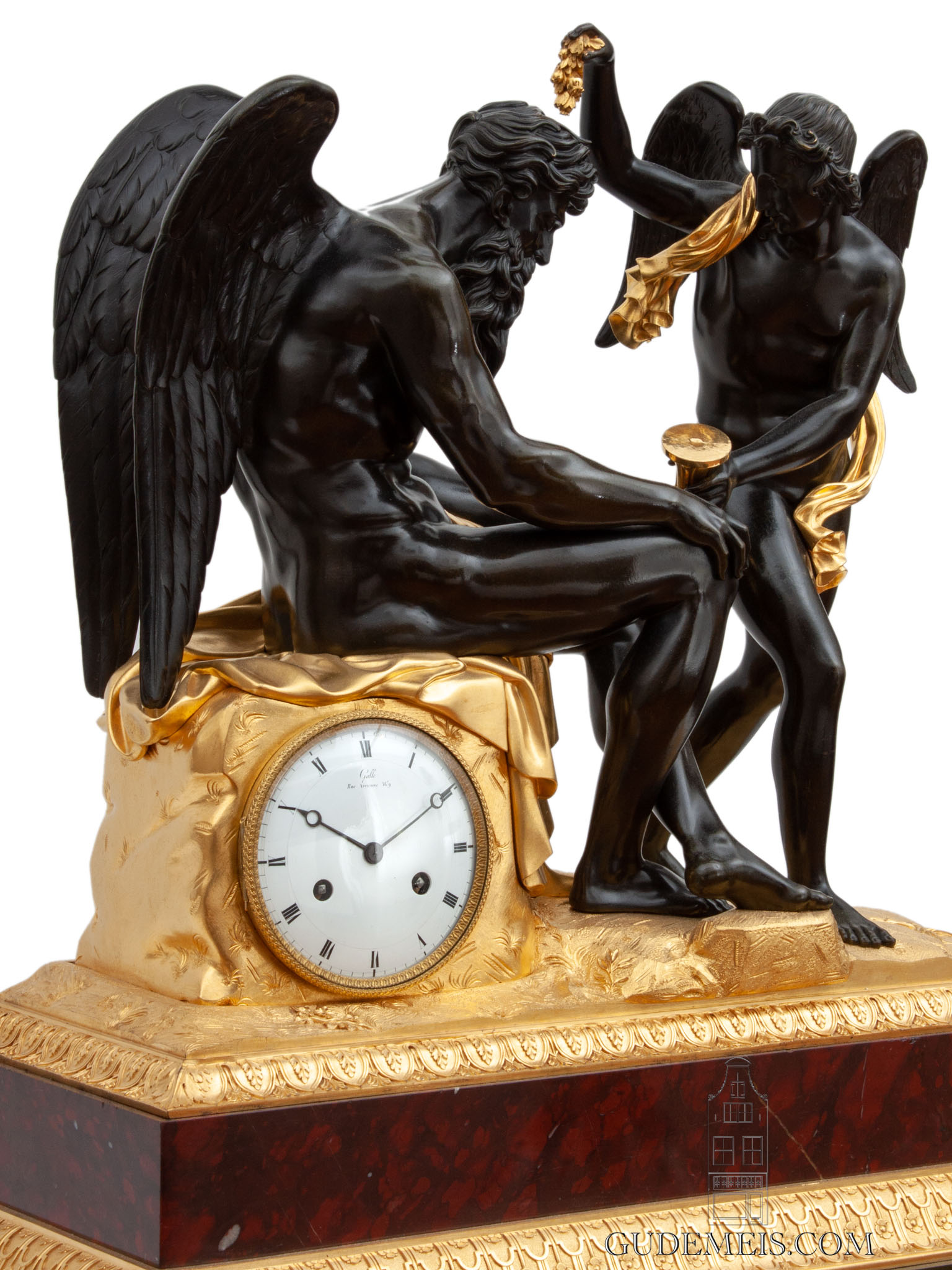
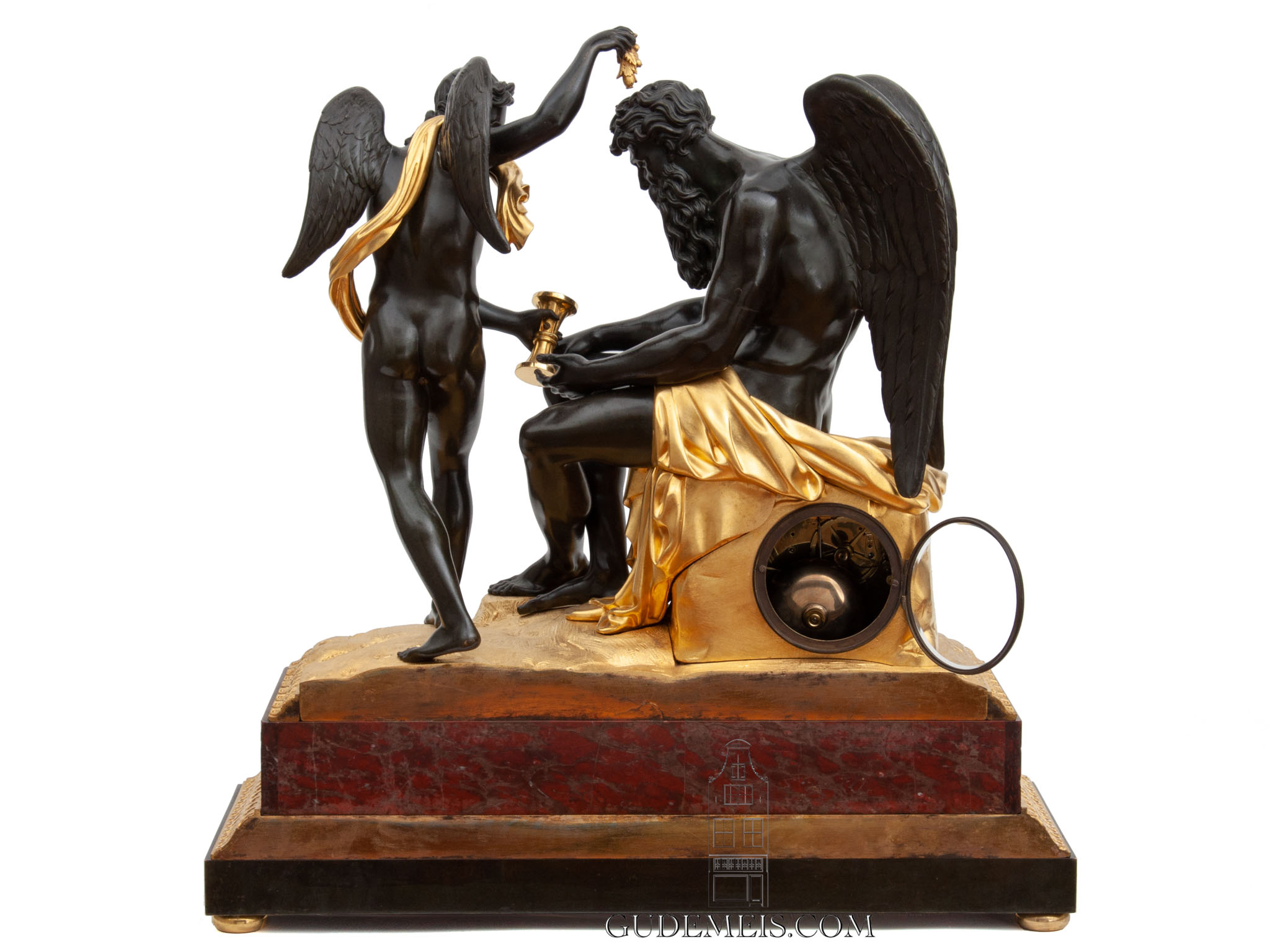
Before anything else, the monumental dimensions of this sculptural mantel clock catch the eye. Not many mantel clocks were made in this ‘palatial’ size, and it must certainly have been made for a very grand interior. The group surmounting the clock is not only beautiful but also tells us a theme. The young, slender Amor is using poppy bulbs with their narcotic properties to lull the older Chronos to sleep while stealing his hourglass. By stealing this, Amor stops ‘Time’ his greatest adversary, since in the end, time destroys everything. But not only are the rare theme and the size exceptional—so is the bronzework. After the French Revolution, very large ateliers evolved, sometimes with hundreds of workmen. This allowed these artisans to specialise and each being responsible for a small part of the production. This led to a very high level of craftsmanship in casting, chiselling, and gilding. Although a layman might think that the quality of Empire mantel clocks is roughly the same, collectors and connoisseurs know better. There is a big difference when one knows what to look for. With this exceptional clock, the natural pose of both figures is captured so well that they seem to move. On closer inspection, the difference in texture between hair, skin, and fabric is amazing. On top of that, the fine detailing of the faces and hair is stunning when we consider that it is all made of bronze. I invite you to study French mantel clocks and look for the differences in quality. But I need to warn you—after you have discovered the beauty of the better pieces, it will be hard to long for something of lesser quality. This clock, exceptional in size, theme, and craftsmanship, is truly a thing of grandeur and beauty.
Both aspects of this sculptural mantel clock are characteristic for the famous maker Claude Galle.
Claude Galle
Claude Galle who is regarded as one of the most imporatant bronziers and fondeur-ciseleurs of the late Louis XVI and Empire periods, was born at Villepreux near Versailles in 1759. He apprenticed with Pierre Foy in Paris and married his daughter in 1784. He became maître-fondeur in 1786 and after the death of his father-in-law he continued the workshop in 1788. He worked together with many great artisans like Pierre-Philippe Thomire and was responsible for many bronze and ormolu objects d’art. Galle moved to Quai de la Monnaie (later Quai de l’Unité), and then in 1805 to 60 Rue Vivienne. He died in 1815. He helped furnishing many famous palaces and many museums have pieces of him in their collections.
The dial
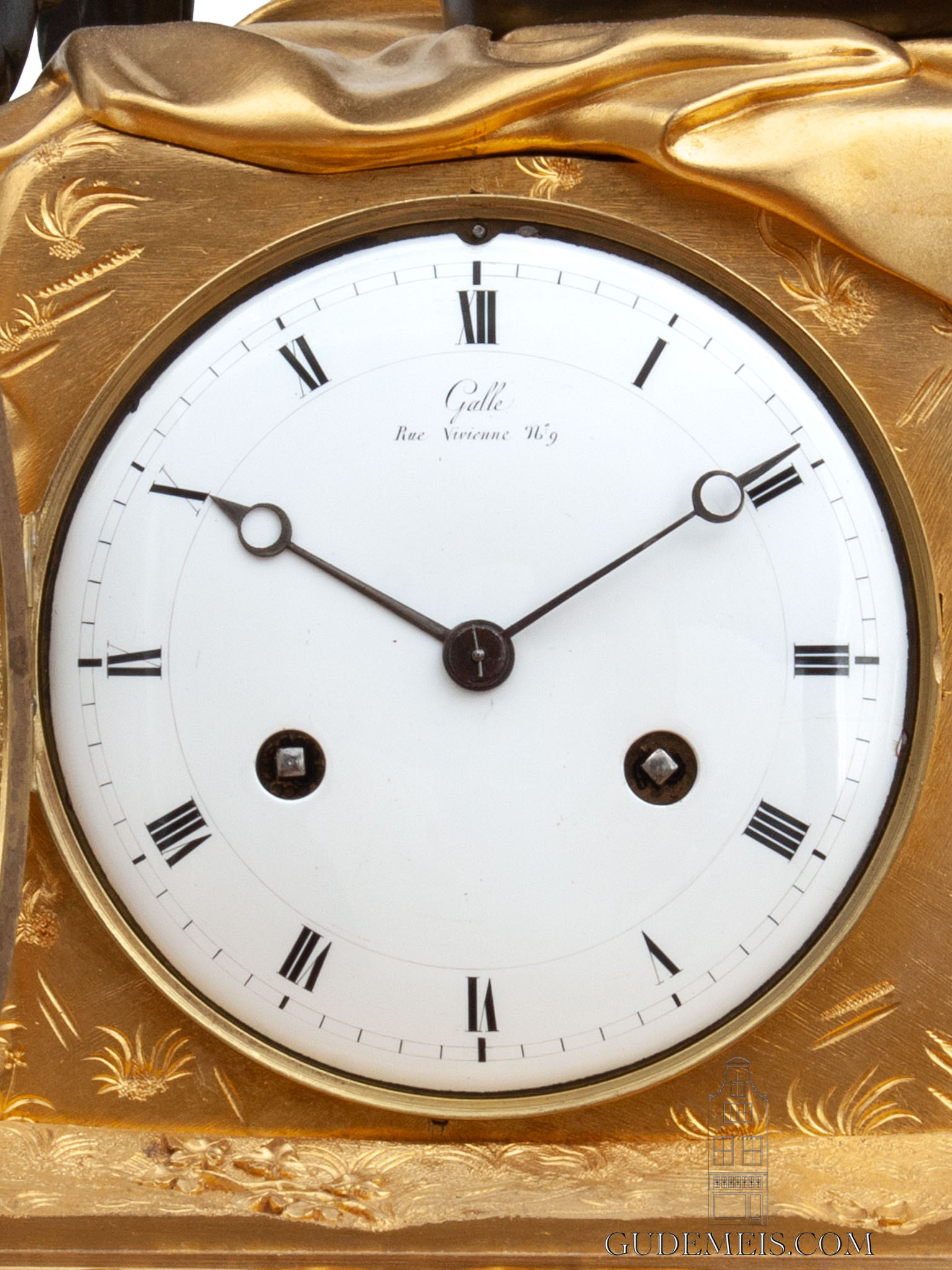
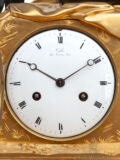
The 11.5-cm enamel dial has Roman numerals and is signed under XII Galle Rue Vivienne No 9. The blued steel hands are of the Breguet type.
The movement
The movement is driven by two spring barrels and has a duration of at least eight days. It is regulated by anchor escapement in combination with a silk suspended pendulum. The clock strikes the hours and half hours on a bell by means of a countwheel. The movement has flat bottomed plates which is more common in this period.
Ormolu and patinated bronze
The movement is fitted in a ormolu case which resembles a natural surface with rocks and plants. On top of it there is a draped cloth on which the sleeping patinated bronze figure of Chronos is seated. In front of him is the turned figure of Amor taking the hour glass. The whole is mounted on a red marble base with finely cast and chiseled ormolu mouldings. The patinated bronze plinth is raised on gilt bronze turned feet.